Wise men from the east

thumbnail

Zoroastrian traditions in Persia and beyond

 24 October 2013 – 27 April 2014 at British Museum, London

Farvahar, Aida Foroutan, 2003. The winged figure is seen by the Iranian artist as a symbol of national identity. © Aida Foroutan 


by Wall Street International

This small exhibition will explain Zoroastrianism, an ancient but living religion named after the Prophet Zarathustra, through objects and coins from Persia (Iran) and beyond.

The display will feature a variety of ancient and modern objects and coins, and will highlight the importance of Zoroastrian traditions in other religions. It will touch on the concept and imagery of the Three Kings of the Christian tradition, who are described in the New Testament (Matthew 2.2) as Magi from the east – Zoroastrian priests in the Persian tradition.

Magnificent Islamic coins from Mughal India which follow the Iranian Zoroastrian calendar adopted by the emperor Akbar (1556–1605) will also be on display.

Modern objects will show the ongoing legacy of this ancient Iranian religion and its significance as a symbol of national identity for Zoroastrian and non-Zoroastrian Iranians in modern Persia and beyond.


Silver coin of Bahram I (AD 273–76), Sasanian king of Iran, showing the Zoroastrian fire altar. © The British Museum

Set of six Parsi tiles from Mumbai, 1980-89, showing in the centre the sacred fire, on the left the legendary King Lohrasp of the Iranian epic tradition, and on the right the Prophet Zarathustra. Donated by Adervad S. Deboo. © The Trustees of the British Museum

Modern gold pendant showing the Zoroastrian winged figure, fravashi/farvahar, which symbolises the immortal spirit of each human being that defends the material world against evil. Private Collection. © V.S. Curtis


Via WSI


Wall Street International Magazine: Wise men from the east


Politics on canvas

thumbnail
Nicky Nodjoumi and the New York enclave
The artist's work transcends borders and displays a worldliness that is a hallmark of Iranian artists in New York.
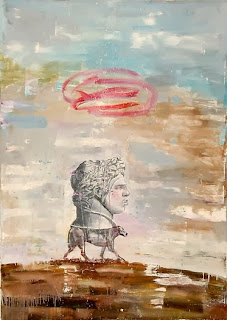
Nodjoumi's artwork walks a fine line between art and politics.
Nicky Nodjoumi, Hasty Retreat, 2012, Oil on Canvas, 70 x 50 in / 177.8 x 127 cm. Courtesy of Taymour Grahne Gallery.

by Hamid Dabashi, Al Jazeera

The corner of Laight and Hudson in New York, where the newly established Taymour Grahne Gallery was exhibiting its very first show, seemed like an odd place for an Iranian artist to reflect back on his lifetime achievement. But early in September, the gallery was the scene of a spectacular opening featuring the large-scale oil paintings of Nicky Nodjoumi, Chasing the Butterfly and Other Recent Paintings.

After decades of unwavering, principled, and quiet work, Nodjoumi has finally arrived as a major aesthetic visionary of his contemporary time, having carved a commanding angle on our lived experiences from the assured perspective of a global worldliness that has patiently and consistently crossed all artificial borders of identity and politics.

Today it is the overwhelming political force of his art that immediately attracts his viewers. The Huffington Post captured the very essence of the evident political implication of Nodjoumi's art when covering his exhibition: "Iranian Artist Nicky Nodjoumi Talks Revolutions, Secret Police And The Vietnam War."

Politics as art

This is perhaps self-evident and even unavoidable. But in response to a question regarding the influence of current politics on his work, Nodjoumi responds: "Yes and no. I follow current events, especially in Iran, almost religiously. Aside from world events, however, I have other preoccupations. Naturally, when I start to work, the political events of the day occupy part of my mind, but imagination is also a part of the function of the mind. Inspirations that shape my work come from a lot of different places." How are we exactly to read that self-professed interface between fact and fantasy, reality and imagination, politics and aesthetics?

On another occasion, a commentator suggested, "Nodjoumi's artwork walks a fine line between art and politics" - in response to which he muses, "I don't have a clear idea. I play with ideas and put them together." That fine line, if we were to follow that appropriate metaphor, is the fact that the politics of our contemporary realities occasions (not influences) Nodjoumi's aesthetics.

In yet another descriptive reading of his work, by Holland Cutter of the New York Times, we read perhaps a more accurate angle on the manner in which politics and aesthetics of Nodjoumi's work cohabit:

"The new paintings at Taymour Grahne are political too, but the tone is different. Visually the work is light, even airy, and filled with absurdist, mocking incident. Men in suits and mullahs in robes share space with horses, apes and apparitional figures from classical Persian paintings. Almost nothing feels grounded or organic: figures are composed of mismatched legs, torsos and heads, and seem unbound by perspective or gravity. Only in a series of magisterial black-and-white ink drawings does the mood tense up." 

To understand the aesthetic force of that cohabitation we need first to come to terms with the imaginative geography of its production.

Storytelling on canvas

I have known Nodjoumi's work since my youth as an undergraduate student in Tehran of 1970's, and have followed his extraordinarily poised and purposeful artistic career closely ever since, and particularly when we both found ourselves living in New York over the last quarter of a century - and I've had many occasions to talk to him and write about his work, on and off camera.

Nodjoumi's surreal hybridisation of historical and phantasmagorical imageries intercut with sharp political commentaries and none of the reviewers who have reported on this show could have missed those strong ingredients. There are as many Shia clerics loitering on his canvases as clean-shaven European- and American- looking businessmen and diplomats; as many people as animals; as many formal occasions as sexually explicit positions.

He is a storyteller with a solid command over his stream of visual consciousness. He draws and paints people and then formally and ceremoniously cuts them into pieces and shapes and designs. He loves to pile people and animals and body organs on top of each other irreverently and provocatively. He paints as if he were an old-fashioned pardeh-dar storyteller, reciting old stories of heroes off a canvas, though his attention span is punctuated and interrupted by the urgency, immediacy, obscenity, and schizophrenic absurdity of the tales he wishes to tell.

Iranian artists' NYC enclave  

Born, raised, and having come to aesthetic consciousness and artistic fame in Iran, Nikzad (Nicky) Nodjoumi was a virtuoso painter long before he packed his belongings and moved to New York. He began to cultivate a distinct artistic signature in his homeland with a visual audacity that was globally resonant long before he came upon greener pastures.

In New York he and a few other Iranian artists - notably his close friends, the preeminent Iranian filmmaker Amir Naderi, the late virtuoso Ardeshir Mohassess, and the globally celebrated Shirin Neshat, become central to the expatriate community of artists who now called New York home. The term exile is a deeply misleading term in this case. Yes these artists, whose invisible enclave includes the pioneering figures of Manouchehr Yektai and Siah Armajani, have been forced to leave their homeland against their will, but the term "exile" also casts them in a nativist disposition that is entirely alien to their work.

Artists like Nodjoumi were worldly when they were in Iran - and they are worldly now that they are in New York. The aesthetic result of this historical fact is the formation of a palpable trans-social signature that defines each and every one of their multiple and varied work. There was as much New York in Nodjoumi when he lived and worked in Iran, as there is Tehran in him now that he lives and works in New York.

There is no difference in this regard among the works of Nodjoumi, Yektai, Neshat, Mohassess, and Naderi. They are as much Iranian as they are American - and that fact categorically dismantles the binary politics of location that habitually exhibits them in one or another curatorial context. The advantage of a solo exhibition of Nodjoumi at Taymour Grahne Gallery is precisely the singular opportunity for this innate quality of the work to come out effectively without the imposition of continued curatorial practices of group exhibitions of one sort or another that keep regurgitating stale and mothballed notions of Eurocentric or (even worse) "parallel" "modernism" ad absurdum.

Understanding contemporary art requires a complete and categorical abandoning of the innately exoticising curatorial practice of the flawed ethnographic gaze that informs much of contemporary art exhibitions and criticism, when it begins and ends (in confirmation or negation) with the designation of an even more flawed category of "Western/non-Western" dichotomy. The politics of location that informs any work of contemporary art must come to terms with the border-crossing fact of all art as it has happened anywhere in the world, effectively imagining a liberation geography constitutionally transgressive against every and all borders. Nicky Nodjoumi's art is a living example of this claim.


Hamid Dabashi is Hagop Kevorkian professor of Iranian studies and comparative literature at Columbia University in New York, and the author of the world of Persian literary humanism (2012).

Via Al Jazeera

My Wicked Persian Carpet

thumbnail

Taymour Grahne Gallery to Present Reza Derakshani's ‘My Wicked Persian Carpet’, 10/29-12/3   


by Visual Arts News Desk, Broadway World

Following its much-touted launch in September 2013, Taymour Grahne Gallery presents new works by Iranian painter, musician and performance artist Reza Derakshani. Expanding on previous investigations of ornamentation and abstraction, "My Wicked Persian Carpet" incorporates the artist's newfound experimentation with materials such as glitter to consider ongoing themes of life and death, faith and fear, love and revulsion, beauty and viciousness, light and darkness. Flat colorfields and a lack of perspective, always a signature component of Derakshani's compositions, meld tradition and political references into highly textured, jewel-like paintings. The series derives its raw strength from an uncomfortable contrast-deceptively beautiful, almost hedonistic decorative qualities cut with bleak, apocalyptic manifestations of death-a result that is hypnotically and universally unsettling.

Born in the rustic countryside of Sangsar, Iran, Derakshani's detailed observation of the natural world is apparent in his work, as is his inspiration from Persian art and folkloric traditions; the imagery of gardens, epics, and miniatures is a critical part of his visual narrative. After leaving Iran in the aftermath of the revolution, Derakshani incorporated influences of Western modernist painting and Persian motifs to develop a visual language of his own, which richly and often piercingly addresses the challenges of calling multiple places home, and the complexity and trauma of modern Iranian cultural history.

This latest series was motivated by Derakshani's return to his native country, where, disappointed by what he saw after decades living overseas, a commentary on the state of Iran today has manifested itself in "My Wicked Persian Carpet." However, as Scott Indrisek writes in his essay accompanying the exhibition catalog: "Defining Derakshani as a political painter would be reductive-shrinking his oeuvre into little more than an extended, anguished salvo against a regime-and it's more interesting to note the unavoidable ways that such concrete realities are instead ingested, and transformed, by the artist."

This is echoed by Derakshani himself, who explains: "I've long tried to steer clear of politics, but it's always been there in the background, and I see the Persian carpet as a symbol of Iran itself. It is something that Persians are proud of, a traditional art that can be absolutely magnificent, yet perhaps we hide behind these traditional symbols. We have huge problems in Iran which we need to face." Nowhere is this more evident than in the work from which the exhibition derives its name: a grinning blue skull stares at the viewer, floating on a thickly layered reworking of the familiar pattern of Persian carpets. Others, such as My Lovely Nuked Red Carpet (2013) continue the theme; the patterns more are subtle, yet through a pixelated haze the rich purple mushroom cloud of a sparkling nuclear reaction takes centre stage, dominating the canvas.

Skulls are at the forefront here, a leitmotif in this series, although they have made prior appearances in Derakshani's work. Works such as Searching for God! (2013) and A Rainbow for Every Life (2013) isolate this memento mori, a macabre reminder of our own mortality suspended in a shimmering sea. And yet, for Derakshani, rather like the Mexican Day of the Dead, there is as much celebration in these skulls as there is a reminder of our own fragility, the cycle of life and death. "By adding glitter, in a way, it makes these skulls beautiful," says Derakshani, "it brings them to life and turns them into a celebration, an affirmation of life."

In the lower gallery, Derakshani will present a series of smaller works inspired by Persian miniatures. Traditional manuscript illustrations have been an obsession of Derakshani's since the late 1980's, and this latest body of work leans further towards abstraction. With disjointed-almost hallucinatory-figures figures and coded hints towards an underlying narrative, the paintings present a fractured retelling of the beloved tragic love story of Shirin and Farhad or the epic Shahnameh, while simultaneously echoing more recent incidents of violence, political upheaval, and social dislocation.


Via Broadway World

Written On The Body/ Politics Of Poetry: Iranian Artists & The Power Of Script

thumbnail
Pt 2, Mixed Bag Mag

Curator Sanaz Mazinani’s show The Third Space is wrapping up this weekend at Toronto’s Harbourfront Centre. Mixed Bag Mag caught up with this busy and multi-talented woman whose career as an artist, educator and curator has her bifurcating herself between Toronto and San Francisco. In the second part (read Part 1 here) of Mixed Bag Mag’s look into the work of contemporary Iranian art Sanaz offers historical background to the contemporary foreground of some of the work included The Third Space and the symbolic and visual power of script.

Avestaaee Script

The History of Calligraphy in Persia


Persian Calligraphy has had a significant effect on the enhancement of Persian arts and culture. The various Iranian Calligraphic styles, such as Taliq, Nastaliq, Naskh, Thulth, Reqa, Towqi, Shekasteh, and Kufic each carry with them an emblem of an era of history. These decorative scripts allow the reader to visually enjoy the composition of the word, in a wholly new way, providing the viewer with multiple levels of engagement with the work of art.


Artist Gita Hashemi‘s Book of Illuminations.
 

Contemporary use of calligraphy by Iranian artists

Many Iranian artists find inspiration in the traditional forms of Persian Calligraphy. However, few are able to successfully marry the traditional forms of calligraphy with a contemporary voice in new and successful ways. One of these artists is Gita Hashemi, whose recent project “The Book of Illuminations” is featured in “The Third Space” exhibition. In this work Hashemi explores the intersection between politics and the personal through calligraphic representations of culturally charged words. Her calligraphy paintings do not merely render poetic verses, but aim to unpack the meaning behind words that we use on a daily basis to symbolically question cultural in-tolerances. One example uses the word “غربتی” which is a derogatory term that comes from the root word “غربت” and means the longing for one’s homeland. But used as an offensive term, it takes on a new meaning and refers to that person as someone who does not belong, and does not fit into the norm. These terms shown here in proximity to the personal narration of the artist’s life writing speak to the expectations placed on us and the limitations of societal benchmarks. Hashemi’s The Book of Illuminations is a fresh approach to the long tradition of calligraphy from Iran and uses a feminist perspective to challenge this traditionally male-dominated, decorative practice by inserting the political into the equation.

In another project, Toronto based artist, Sona Safaei, uses the Farsi and English alphabet and essay writing styles  to uncover the differences in the two languages, which intern demonstrate alternative ways of thinking through a subject. Her process often engages with lost meanings in translations, as she questions the possibility of communications across cultures through looking at the self and the feelings associated with otherness. In The Third Space exhibition, Safaei-Sooreh two works respond to the meeting of two languages (English and Farsi). In Alphabet, the viewer finds herself in front of a split screen video as the camera tracks two alphabets being hand written in pencil – one in English, from left to right, and the other in Farsi, from right to left. A dense and textured sound enhances the experience of watching each gesture. The sounds from the left and right videos combine in a seamless collaboration. An amalgamation occurs precisely at the moment when the video loop comes to a close and both sets of alphabets have been written out tin their entirety. This charming momentary union marks an important occurrence, as the English alphabet includes 26 letters and the Persian alphabet 32, this serendipitous synchronicity signals a potential for cohesion of these two cultures. Safaei-Sooreh’s second work titled, Border is a dual channel video installation in which two sets of texts on the subject of art intersect at the corner of a room. The writing disappears on the borderline where adjacent walls meet, creating a unique experience for the viewer, as the piece examines the duality of experiences always at play in transcultural situations.

 Artist Gita Hashemi‘s Book of Illuminations.

 Artist Sona Safaei-Sooreh’s Alphabet.


The Third Space is on at the Harbourfront Centre’s York Quay Gallery. For more information visit the website.

All above images courtesy of curator Sanaz Mazinani and Mixed Bag Mag.


Related Post:
WRITTEN ON THE BODY/ POLITICS OF POETRY: Iranian Artists & the Power of Script Pt 1


SubRosa: The Language of Resistance

thumbnail
SubRosa: The Language of Resistance runs until December 7, 2013  at the USF Contemporary Art Museum.

Artists include Ai Weiwei (China), Ramón Esono Ebalé (Equatorial Guinea), Barbad Golshiri (Iran), Khaled Jarrar (Palestine), Zanele Muholi (South Africa), and José Toirac and Meira Marrero (Cuba). Curated by Noel Smith; Organized by USFCAM; Made possible in part by a grant from the National Endowment for the Arts, and supported by the USF Institute on Black Life and EG Justice.


The exhibition, curated by Noel Smith, examines the art and language of artists in response to social, political, and environmental repression. Although the political agency of art is regularly debated, there is a growing group of artists today who make work with political agency and relevancy in mind. Covering continents and cultures, these artists share a desire to question dominant political systems and the prevalent status quo, sometimes covertly and dangerously. More broadly, SubRosa, titled for the Latin phrase meaning secrecy, poses several questions about the role of art in political life.

You’re probably familiar with at least one of the artists who have work in the exhibition. But we wanted to share a bit about an artist you may not be immediately familiar with, Iranian artist Barbad Golshiri. Golshiri will soon have a solo exhibition entitled Curriculum Mortis at Thomas Erben Gallery in New York.

As Dad as Possible, as Dad as Beckett, Barbad Golshiri, 2000 – 2013, Iron, ashes, 200.3 x 100.2 x 28.3 cm. Courtesy USF CAM. 

Barbad Golshiri


Barbad Golshiri is a contemporary artist who was born in 1982 in Tehran, Iran. He continues to work and live in Tehran, even as his work is considered controversial in the place he calls home.

 
“Tombstone for Borges’ Assassinated Translator” (Ahmad Mir-Alaei), Barbad Golshiri, 2012, Engraving on stone, ~ 60 x ~ 81 x ~ 10 cm. Courtesy AAran Art Gallery and USF CAM. 


Thomas Erben in collaboration with Aaran Gallery, is excited to present Curriculum Mortis, a sculptural installation of a cemetery, by Iranian multimedia artist Barbad Golshiri, his second solo exhibition with the gallery after Nothing Is Left to Tell in 2010. As one of the most prominent figures on the Iranian contemporary scene, over the past ten years Golshiri has produced esthetically and conceptually provocative art, in an impressive balancing act between political urgency and repressive conditions.

Considering the urgent presence of the body, with all its most primal and visceral functions, death has played an important if understated part throughout Golshiri’s art. In Curriculum Mortis, it becomes the main theme through which all other aspects are filtered, as physical bodies are replaced with tombstones, turning the gallery into a graveyard. How do we deal with the loss of those close to us, when they are killed under unclear circumstances, in a society where no authority can be trusted? Golshiri approaches each death individually, creating grave markers so closely attuned as to become physical manifestations of the people they commemorate. Tombstone for Borges’ Assassinated Translator, for example, incorporates engravings referring to the stories translated by Ahmad Mir-Alaei, a well-known translator who disappeared and was later found dead, allegedly from cardiac arrest. By creating these tombstones, Golshiri gives voice to those whose words have forcibly been taken from us, and gives them a renewed physical presence in the world, refusing to forget.


Perpetual Is He, Barbad Golshiri, 2012, Engraving on cow skull, iron, industrial wax .36 x 23 x 18 cm. Courtesy AAran Art Gallery.

Not all graves commemorate victims of oppression; as is true for Golshiri’s production as a whole, this series of tombs reverberate with subtext, and the artist’s own personal history is as deeply entwined in the work as the histories of the dead. There is the grave of Samuel Beckett, whom Golshiri has translated into Persian; a stone with the epitaph “[There is] no God”; a Tombstone of Jan van Eyck; and finally Golshiri’s own tombstone. Walking through this makeshift graveyard, we are moving through a mindscape of the artist; each grave presents a portal into worlds beyond the present one, where transformation is possible and all can – finally – be different.

Barbad Golshiri’s solo exhibition in New York Curriculum MortisThomas Erben Gallery in collaboration with Aaran Gallery runs September 7 – October 26, 2013.

 You can see work from Barbad Golrishi at the USF Contemporary Art Museum right now!

The Distribution of the Sacred System, Barbad Golshiri, 2010, Installation and aktion, Silk screen print on canvas, 180 x 69 cm, unlimited editions, Iron pulley: ∅ 150 cm, length: approx. 240 cm. Courtesy AAran Art Gallery and USF CAM. 
 
Installation overview at Contemporary Art Museum USF. Courtesy AAran Art Gallery and USF CAM. 


Via USF Contemporary Art Museum and Aaran Gallery

Calligraffiti

thumbnail

Deitch Takes Another Look at ‘Calligraffiti’ for New York Gallery


Leila Pazooki, This Is Not Green, 2009,  Illuminated neon tubes,  19.29 x 78.74 in / 49 x 200 cm. Courtesy Leila Heller Gallery.


by Carol Kino, The ArtsBeat, New York Times

Last month Jeffrey Deitch resigned as the director of the Museum of Contemporary Art, Los Angeles. Although he won’t step down immediately, the art world is abuzz with rumors about what he’ll do next. Perhaps a clue to his future interests may be found  in “Calligraffiti: 1984-2013,” an upcoming show at the Leila Heller Gallery in Chelsea opening Sept. 5.

It will explore the relationship between graffiti and calligraphy with the work of nearly 50 artists, from Jackson Pollock and Jean-Michel Basquiat to Keith Haring and his protégé “LA II” (as Angel Ortiz is known). Many of the artists are Middle Eastern, including Shirin Neshat and Hossein Zenderoudi, and several are street artists, like the French-Tunisian star eL Seed.

The show essentially updates “Calligraffiti,” an exhibition that he and Ms. Heller collaborated on in 1984, back when he was a Citibank art adviser with a passion for street art, and she was an Upper East Side dealer specializing in art from the Middle East, primarily Iran.

Curated by Mr. Deitch, the 1984 show juxtaposed graffitists like Fab Five Freddy with Mr. Zenderoudi and modernist scrawlers like Cy Twombly and Jean Dubuffet. (Mr. Deitch came up with the idea, he said, while he was between apartments and sleeping in Ms. Heller’s gallery.)

This time, Mr. Deitch served as Ms. Heller’s sounding board, rather than curator. But he is excited about the new possibilities for street art offered by the turmoil in the Middle East, especially as exemplified by eL Seed, who started as a street artist and is now working on a major commission from the Qatar Museums Authority to paint a series of tunnels in Doha.

“He is in a very genuine way working in this fusion between a calligraphic technique coming out of Arabic script,” Mr. Deitch said, “and an awareness of international graffiti language. When we did the show originally in 1984, there wasn’t anyone like this.” But now, he added, “there is this actual fusion of the two traditions.”

In the catalog he wrote that, ”Graffiti has become an important part of the imagery that has defined the Arab Spring.” While New York’s early taggers had to rely on subway cars to carry their messages, he added, “today new communications platforms like Instagram and YouTube have given street art a new resonance,” instantly communicated around the world.

Mr. Deitch is already at work on several independent projects beyond the one or two he intends to complete for the Museum of Contemporary Art. He would not talk about them until he had “concrete plans with the dates, space.” But yes, he confirmed, they will be in New York.

Pouran Jinchi, Transparency #13, 2012, Plexiglass and permanent marker, 23 x 3 in / 58.42 x 7.62 cm. Courtesy Leila Heller Gallery.

Shirin Neshat, Zahra, 2008, C-print and ink, 11 x 14 in / 27 x 36 cm, Unique. Courtesy Leila Heller Gallery.

 
 Hadieh Shafie, Grid 27, 2013, Ink and acrylic on Arches paper, 29.5 x 41 in / 75 x 104 cm. Courtesy Leila Heller Gallery.

Farhar Moshiri, Untitled (My Heart is Your Love’s Play Toy), 2004, Oil on canvas, 57 x 44 in / 144.8 x 111.8 cm. Courtesy Leila Heller Gallery.

Jackson Pollock, Untitled 1, 1951 (Printed 1964),  Screen print,  23 x 29 in / 58.42 x 73.66 cm. Courtesy Leila Heller Gallery.


Via Leila Heller Gallery and The ArtsBeat, New York Times

Modern and Contemporary Iranian Art, On Display and In Demand

thumbnail
Masters of Persian, Reza Derakshani (2008). Mixed media on canvas.  Courtesy Muftah.

by Nima Shirazi, Muftah

An upcoming exhibition at the Asia Society in New York City will highlight over 100 pieces of pre-revolution Iranian art – paintings, photography, drawing and sculpture – created by “the most noteworthy Iranian artists of the 1950s to 1970s” compiled to “shed light on a period when Iranian artists were engaged with the world through the Tehran Biennial in Iran as well as exhibitions overseas, and when their work was collected by institutions inside and outside of Iran.”

The landmark loan exhibition, entitled Iran Modern and running from September 6, 2013 to January 5, 2013, “maps the genesis of Iranian modernism in order to argue that the development of modernist art is inherently more globally interconnected than previously understood” and “provides a dynamic perspective on Iran’s rich culture and history for the public.”

Meanwhile, a recent article in Art Radar Asia, an online magazine that tracks contemporary art trends, calls Iran “one of the most prolific and productive countries for contemporary art” in the Middle East and identifies eight innovative, influential and internationally-renowned Iranian artists of the past 35 years.

Included in Art Radar‘s list and accompanied by concise and illuminating blurbs about their work are photographer Abbas Kowsari, abstract calligrapher Golnaz Fathi, and painters Afshin Pirhashemi, Alireza Adambakan, and Babak Roshaninejad.

Here is an excerpt:

Reza Derakshani

Born in Sangsar in 1952, painter, musician and performance artist Reza Derakshani grew up in a tent in the countryside. His nomadic childhood inspires his art. He studied art in Tehran and Pasadena, California. In 1983, following the Islamic Revolution, he lived in exile in New York and Italy. He currently lives and works in Dubai and Austin, Texas.

Derakshani’s gallery, Kashya Hildebrand, had this to say about the artist and his method of working: “By investigating the essential nature of his cultural identity in a singularly original manner, he has connected to the spirit of the most exciting art made internationally today.”

Derakshani’s artwork is collected by high-profile figures such as Leon Black, Sting and Trudie Styler and the Royal family of Abu Dhabi. The British Museum has recently commissioned new works.

Afshin Pirhashemi

Afshin Pirhashemi, born in 1974 in Urmia, where he lives now, is known for his black and white photo-realistic paintings of women.

His artistic talent was seen from childhood. As a teenager, he received a grant from the Italian Ambassador to study at the Rome Art Academy, and then received his BA at Azad University.

According to ArtTactic, the price range for his paintings is from USD 10,000- 50,000, and he is listed as having high market confidence. Pirhashemi won awards for his painting at the 2003 Tehran 6th International Art Biennial, and the 2004 Beijing Art Biennial Award.

Farhad Moshiri

According to Galerie Thaddaeus Ropac, Tehran-based Farhad Moshiri, who was born in Shiraz, Iran, in 1963 and educated at California Institute of the Arts, “overturns both pop culture and highbrow imagery by transforming it into figurative artwork.” His works are often hand-embroidered and sparkle with his use of glitter, sequins, and crystals. Even though his shimmery works look playful, he is addressing  ”the flaws of contemporary Iran all while toying with its traditional forms; he acknowledges the appeal of the western world in addition to its limitations.”

Marriage, Afshin Pirhashemi (2012). Oil on canvas. Ayyam Gallery. Courtesy Muftah.

God in Color, Farhad Moshiri (2012). Hand embroidery on canvas. Galerie Perrotin. Courtesy Muftah.

From high-priced auctions in Tehran to exhibitions in New York, Iranian artwork from the past six-plus decades – created in the midst of monarchy, modernization, foreign intervention and popular revolution – never ceases to reflect the complexity of Iranian culture, reinvent itself, attract attention and amaze the world.

Untitled, by Abolghassem Saidi (1973). Oil on canvas. Collection of Sam Bayat and Charlotte Denise Madeleine Bayat. Courtesy Muftah.

Via Muftah

The Sincere Art

thumbnail

In Memory of Sadegh Tirafkan, Iranian artist and photographer

Sadegh Tirafkan, Iranian Man, 2000, digital photo, edition 5 of 6, 64×48 cm. Courtesy AB Gallery Luzern & Zürich and ArtAsiaPacific.


by Mehran Mohajer, ArtAsiaPacific

This past May, the Iranian art community mourned the loss of Sadegh Tirafkan, one of the country’s “new art movement” pioneers, to brain cancer at the age of 47. Known for his innovative blending of photography with other artistic media, Tirafkan was an early proponent of photo-based art in Iran and a prominent international representative of Iranian contemporary art.

Born in Karbala, Iraq, to Iranian parents in 1965, Tirafkan spent his childhood and adolescence in Ahwaz, southern Iran, where he volunteered to join the Iranian army during the war between Iran and Iraq (1980–1988). His early experiments in theater and filmmaking as a teenager led him to apply for a degree in photography at the Faculty of Fine Arts at the University of Tehran on leaving the army. After graduating in 1990, Tirafkan remained committed to developing his own visual idiom, and it was this that set him apart from the many artists whose practices were informed by official narratives, or who were pursuing the dominant current of war-oriented documentary photography.

Though Tirafkan’s early works may ostensibly appear to be documentary in nature, the level of dramatic expression betrays a subconscious tendency toward staging, which can be attributed to his cinematic eye. Tirafkan adopted a method of “constructed photography,” combining the photographic image with hints of painting, a practice developed in tandem with his experiments in new media. His friendship with the painter Parvaneh Etemadi also had a strong impact on his work.

While the exploration and use of traditional Iranian imagery is perhaps common among Iranian artists today, Tirafkan should be credited as one of this style’s originators. Choosing historic sites like Persepolis and Susa as his settings and referencing Iranian post-Islamic history—the Ashura ceremony, Iranian ritual champion wrestling, miniature painting and carpet motifs—Tirafkan introduced themes such as the traditional identity versus the modern identity, notions of the self and the problematizing of male psyche.

In The Iranian Man (2000) and Temptation (2004–5), the conceptual framework of male violence contrasts with the typical aestheticization of the body, creating an unfathomable anxiety. Here, through the direct or indirect use of the genre of self-portraiture, Tirafkan manages ingeniously to integrate the archetypal triple roles of “the artist,” “the narrator” and “the actor”, which frequently appear in traditional, staged studio photography. Covertly, and without disrupting representational norms, Tirafkan poses serious questions about Iran’s patriarchal culture and about society at large.

Tirafkan’s fastidiousness and perseverance pervades the entirety of his oeuvre. In 1986, within the extremely restrained socio-political atmosphere that followed the Cultural Revolution, he, along with some classmates, organized one of the first independent photography exhibitions in Tehran at the Ketab Azad gallery. It is for such examples of dogged commitment to his work that he should be remembered.

Translated by Helia Darabi.

Sadegh Tirafkan’s works are permanently housed in the collections of the Tehran Museum of Contemporary Art, British Museum, Brooklyn Museum and Los Angeles County Museum of Art.

Mehran Mohajer is an Iranian scholar and art photographer. He is a faculty member of University College of Fine Arts, at the University of Tehran and is one of the major translators of photography and art theory textbooks in Iran.

Sadegh Tirafkan, Whispers of the East 7, 2006–7, digital photo collage, edition 5 of 6, 130×72 cm. Courtesy AB Gallery Luzern & Zürich and ArtAsiaPacific.

Sadegh Tirafkan, No. 4,  2012, mixed media with photos, 128×183 cm. Courtesy AB Gallery Luzern & Zürich and ArtAsiaPacific.

Sadegh Tirafkan, Human Tapestry 9, 2011, mixed Media, digital photo with hand knitted carpet frame, edition of 6, 148×185 cm. Courtesy AB Gallery Luzern & Zürich and ArtAsiaPacific.

Sadegh Tirafkan, Whispers of the East 4,  2006–7, digital photo collage, edition 5 of 6, 130×72 cm. Courtesy AB Gallery Luzern & Zürich and ArtAsiaPacific.